Core guide
Wagering requirements explained: the base, the multiplier and the contribution rate decide what you actually stake
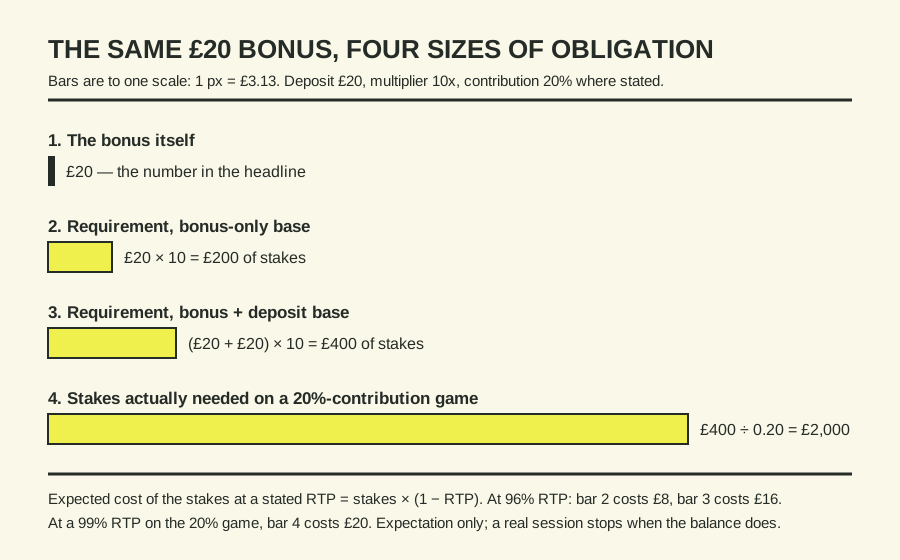
A 10x requirement on a £20 bonus is £200 of stakes if the base is the bonus, £400 if it is bonus plus deposit, and £2,000 of stakes on a game that contributes 20%. Every step is shown, every clause is quoted from the operator or regulator that wrote it, and the calculator below repeats the arithmetic on your own numbers.
The regulator’s definition, and the three numbers it hides
The Gambling Commission’s glossary for its fair-terms guidance defines wagering requirements as “any requirement that a consumer must make wagers totalling a particular value for funds to become withdrawable, whether the total requirement is expressed as a fixed amount or as a multiple of another amount, such as the size of a deposit made by, or bonus received by, the consumer.” The same entry excludes a bare play-once condition, “but only if the bonus terms allow the consumer immediately to withdraw any winnings from wagering that bonus.”
Two things in that sentence do the work. The requirement is a total value of wagers, not a number of bets and not an amount lost. And it is “a multiple of another amount”, which means the multiplier on its own tells you nothing until the document names the amount being multiplied.
Operators say the same thing in their own words. William Hill’s help page: “A Wagering Requirement requires you to wager a certain amount on the game/s specified within the terms and conditions of the promotion before your Bonus Balance is transferred into your main balance.” Betfair’s casino FAQ: “a multiplier that represents the number of times you have to play though a bonus before you are able to withdraw any winnings.” Both definitions contain three quantities that are easy to skim past: the base, the multiplier, and which games count. A fourth, the contribution rate, appears a paragraph or two later in each document.
Sources: Gambling Commission: glossary of terms, fair and transparent terms and practices; William Hill: What’s a wagering requirement?; Betfair: Casino Promotion FAQs.
The base: bonus only, or bonus plus deposit
A “10x” clause multiplies something. In the Commission’s definition it may be “the size of a deposit made by, or bonus received by, the consumer”, and in practice it is one of two bases: the bonus alone, or the bonus and the deposit added together. The difference doubles the obligation on a matched offer, and the wording that tells you which base applies is usually a short phrase such as “10x the bonus” or “10x the deposit and bonus amount”.
This distinction is the single largest source of error in the published research. The Behavioural Insights Team, testing offer formats on 4,012 UK adults who gamble, reported that “7 in 10 people could not calculate how much they would need to bet to meet a wagering requirement”, and that the figure rose to “almost 9 in 10 when a wagering requirement applied to both the combined value of the bonus and the deposit amount”. Their proposal to the Commission was to “Ban ‘bonus + deposit’ wagering requirements”. The Commission’s final rule did not adopt that; the 10x cap in code 5.1.1 refers to requirements “which requires a customer to play through bonus funds”, and the consultation response does not define whether a deposit-inclusive base is within or outside the cap. That is left unresolved here because the source leaves it unresolved.
Our shorter note on reading the base before the multiplier covers the habit; this page does the sums.
Sources: Behavioural Insights Team: Testing the impact of different wagering requirement levels (results); Gambling Commission: LCCP SR code 5.1.1 Rewards and bonuses.
The arithmetic on a £20 bonus, step by step
Take a £20 deposit, matched with a £20 bonus, at 10x. Nothing here is a live offer; the figures are chosen because they divide cleanly and because 10x is now the ceiling for bonus funds in Great Britain.
Step 1, name the base. Bonus-only: £20. Bonus plus deposit: £20 + £20 = £40.
Step 2, apply the multiplier. Bonus-only: £20 × 10 = £200. Bonus plus deposit: £40 × 10 = £400. That figure is the requirement as written: total qualifying stakes before the bonus balance converts.
Step 3, count down. William Hill describes the mechanism as a running balance: on a £5 bonus at 10x, “If you stake £1, this would be deducted from the Wagering Requirement and you would need to stake a further £49 (i.e. £50 – £1 = £49) before you could withdraw any Bonus Funds.” Each qualifying stake reduces the remaining requirement by the stake, or by a fraction of it if the game contributes less than 100%. Winnings do not reduce the requirement; only stakes do.
Step 4, put a cost on it. A wagering requirement is not a loss, but stakes have an expected cost, and the game’s published return to player is the rate. Expected cost = stakes × (1 − RTP). At 96%: £200 × 0.04 = £8 for the bonus-only case and £400 × 0.04 = £16 for the deposit-inclusive case. Against a £20 bonus, those are the expected amounts the requirement eats before the balance is yours.
Virgin Games’ own explainer runs the same shape at a larger scale, describing a £100 bonus at 10x as £1,000 of stakes before withdrawal. Betfair’s FAQ uses £20 at 10x, “This means I need to spend £200 on eligible games”. The word “eligible” in that sentence is where the next section starts.
Sources: William Hill: What’s a wagering requirement?; Virgin Games: Minimum wagering requirements; Betfair: Casino Promotion FAQs.
Contribution turns a requirement into real stakes
Every operator page fetched for this article carries a version of the same caveat. William Hill: “For some promotions, stakes on certain games may only reduce the remaining Wagering Requirement by a certain percentage of the original stake.” Betfair: “Stakes on some of our games mat [sic] not count in full towards the wagering requirement, Standard Game Weightings may apply.” Betway’s general bonus terms publish the weightings as a table: slots “100%”, certain table games, roulette and video poker “8%”, excluded games “0%”.
A contribution rate is a discount on the credit you receive for a stake. If a game contributes 20%, a £10 stake reduces the requirement by £2. To reduce a £400 requirement to zero on that game you must stake £400 ÷ 0.20 = £2,000. At Betway’s published 8% for some table games the same £400 requirement is £400 ÷ 0.08 = £5,000 of stakes. At 0% the game is a way of spending the balance without progressing at all.
So the general formula, with S the stakes you must actually place, B the base, m the multiplier and c the contribution rate as a decimal:
S = B × m ÷ c
The requirement as written (B × m) is what the terms show. S is what you do. The gap between them is the part of the clause the Commission chose not to regulate: its consultation response says “we do not think it is necessary to review rules on weightings attached to wagering requirements at this time”, giving as its own illustration a £100 bonus at 10x on slots “weighted at 50 percent for blackjack and 30 percent for roulette”.
Sources: Betway: General bonus terms; Gambling Commission: consultation response, proposal 1, wagering requirements.
Contribution is not RTP, and expected cost is not a forecast
Two percentages sit near each other in a bonus document and measure different things. Contribution is a counting rule: what fraction of a stake is credited against the requirement. Return to player is a long-run average of what a game pays back per unit staked. A slot can contribute 100% and return 96%; a blackjack table can contribute 8% and return over 99%. Neither number tells you the other. Our decoder on contribution versus return covers the confusion; Reel & Story is the place for how RTP itself is calculated and published.
Expected cost uses RTP, not contribution, and it is an expectation, not a prediction. Expected cost = S × (1 − RTP). In the 20% example above, £2,000 of stakes on a game returning 99% has an expected cost of £2,000 × 0.01 = £20, the whole bonus. On the slot example, £200 at 96% has an expected cost of £8.
There is a break-even multiplier hidden in that formula. The expected cost of clearing equals the bonus when m × (1 − RTP) ÷ c = 1. On a 100% contribution game at 96% RTP that is m = 1 ÷ 0.04 = 25: above 25x, clearing is expected to cost more than the bonus is worth. At 95% it is 20x; at 98% it is 50x. The Commission’s consultation recorded that some licensees “currently apply up to 60 times wagering requirements” before the cap.
The limits of the expectation matter. It assumes the requirement is completed, which a real balance often does not survive; it ignores any cap on winnings from bonus play; and it ignores variance entirely. A £8 expected cost is consistent with losing £20 quickly and with finishing ahead. The BIT supplementary report puts it flatly: “For slot games it is impossible for consumers to know the probability of winning money from a WR” except at the simplest 1x level.
Sources: Gambling Commission: consultation response, proposal 1; Behavioural Insights Team: supplementary results on perceived chances of winning.
The calculator
Enter the figures from a bonus document and the worksheet repeats the four steps above, then adds the stake cap and expiry arithmetic from the next section. It runs entirely in this page, holds no account data and models no live offer. Two presets reproduce the worked examples: Example A, bonus-only slot and Example B, bonus plus deposit on a 20% game. The “Copy link” control writes your inputs into the address so a specific example can be sent to someone.
Worksheet
Wagering requirement calculator
Arithmetic only. A stake cap and an expiry are read from the promotion’s own terms; the defaults here are illustrative. Whether an offer is available, lawful or worth accepting is not a question this worksheet answers.
Stake caps, expiry clocks and the balance the clause attaches to
Three further clauses shape how the required stakes can be reached. None changes S; each constrains the path to it.
Maximum stake. 32Red’s promotional terms list, under a bonus-abuse heading, “Betting more than 30% of the initial bonus amount in any one game round” until requirements are met, and “Betting more than £15 per spin on slots while using bonus funds”, with the stated consequence of “forfeiture or blocking of any points, bonuses, prizes and/ or winnings”. On a £20 bonus the 30% rule is a £6 ceiling per round. A £200 requirement at £6 per round is at least 200 ÷ 6 = 33.3, so 34 rounds; a £2,000 requirement is at least 334 rounds. The calculator reports that minimum. The CMA’s advice to gamblers says such limits “must be made clear to you”, which is a disclosure duty, not a limit on the figure.
Expiry. Betfair: bonuses are “valid for a period of 7 days from the date of issue unless otherwise stated in the specific promotion.” Betway: “all Flexi bonuses are valid for 7 days after the point of activation.” Divide the minimum rounds by the days and you have the least activity the requirement demands per day; 34 rounds over 7 days is about five a day, 334 rounds is about 48. The clock’s start, issue or activation, is a separate fact to record from each document.
Which balance. The Commission’s glossary separates the “Deposit balance”, which “always includes: unspent funds paid in by a player” and “all winnings from wagers made with the deposit”, from the “Restricted funds/Bonus balance”, which comprises “any bonus which is not immediately withdrawable” and “all winnings made with the bonus, which are subject to uncompleted wagering requirements”. William Hill’s 2018 undertaking to the CMA states, at paragraph 6, that “Promotional Play Restrictions and Wagering Requirements (if applicable) do not apply to any play by a consumer with their Deposit Balance”, and at paragraph 4 that the operator will “Allow consumers to withdraw their Deposit Balance at any time (including when a Bonus is pending or active on the account) and without restriction”. Betway’s terms describe the exit: “You can withdraw your cash balance at any time! All that happens is you forfeit your current bonus balance at the time of withdrawal.” What happens to a withdrawal request once it is made is Payout Ledger’s territory; this page stops at the clause.
| Operator page | Definition or worked figure | Contribution wording | Stake cap or expiry wording |
|---|---|---|---|
| William Hill, “What’s a wagering requirement?” | “requires you to wager a certain amount on the game/s specified … before your Bonus Balance is transferred into your main balance”; £5 at 10x = £50 | “stakes on certain games may only reduce the remaining Wagering Requirement by a certain percentage of the original stake” | Not on this page |
| Betfair, “Casino Promotion – FAQs” | “a multiplier that represents the number of times you have to play though a bonus”; £20 at 10x = £200 “on eligible games” | “may not count in full … Standard Game Weightings may apply” | “valid for a period of 7 days from the date of issue unless otherwise stated” |
| Betway, “General bonus terms” (en-uk) | Stakes drawn “from your cash balance and your bonus balance at your BCR ratio”; guide example uses €/$ figures at 50x and 30x | Slots “100%”; certain table games, roulette, video poker “8%”; excluded games “0%” | “valid for 7 days after the point of activation”; withdrawing cash means “you forfeit your current bonus balance” |
| 32Red, “Promotional terms and conditions” | Not defined on this page | Not on this page | “Betting more than 30% of the initial bonus amount in any one game round”; “Betting more than £15 per spin on slots while using bonus funds” |
One caution on the Betway row: the page sits at an en-uk address but its worked example is in euros and dollars at 50x, a figure above the Great Britain cap. The page does not state which jurisdiction that example describes, so it is recorded here as wording, not as a Great Britain offer.
Sources: 32Red: Promotional terms and conditions; CMA: Online gambling promotions, advice for gamblers; CMA: Undertakings given by William Hill; Betway: General bonus terms.
What the 10x cap changed on 19 January 2026, and what it left alone
LCCP social responsibility code 5.1.1, which applies to “All licences (including ancillary remote licences), except gaming machine technical and gambling software licences”, now says licensees must not “Apply wagering requirements, which requires a customer to play through bonus funds, over a maximum of 10 times”, and must not “Include more than one type of gambling product (betting, casino, bingo, and lottery) within an incentive.” The Commission’s announcement gives the reasoning: “Capping the wagering requirement to ten decreases the likelihood of harm, reduces complexity, and improves transparency while maintaining consumer choice.” The same announcement carries a correction: “The date for implementation has been changed from 19 December 2025 to 19 January 2026.”
The cap fixes m. It does not touch c, the stake cap, the expiry or the base. A 10x requirement met on an 8% game is still 125 times the base in stakes. The consultation response records one operator’s disclosure that “75 percent of their offers apply within the 1 to 10 times wagering requirements” already, alongside the observation that some licensees applied “up to 60 times”. Both figures are the Commission’s summary of submissions, not a market survey.
Older rules still sit underneath. The CMA’s 2016 to 2019 investigation targeted terms that put “restrictions on their right to withdraw winnings made from gameplay with their deposit unless they meet extensive wagering requirements”, and its do’s and don’ts for firms, published 29 August 2018, include “Allow customers to exit promotions at any time with their remaining deposit, plus any winnings from play with their deposit” and “Ensure customers can clearly distinguish between playing with bonus funds and playing with their own money.” The Commission’s transparency guidance requires significant conditions “in a clear, timely, intelligible, unambiguous, transparent, non-misleading and prominent manner”, and adds that “Simply including the information in website terms and conditions is not sufficient.”
Advertising has its own layer. CAP’s advice on free bets and bonuses lists “Deposit or wagering requirements” among conditions likely to be significant, states that “All marketing communications or materials referring to promotions must clearly and prominently communicate all applicable significant conditions if their omission is likely to mislead consumers”, and that “Marketers should not describe an offer as ‘free’ if the customer must risk their own money to qualify.” Its online casinos page says significant conditions under Code rule 8.17 “are likely to include any minimum stakes, details of how to participate in the promotion and any wagering requirements.” The Commission’s consumer page on free offers says companies should “make it clear if you’re playing with your own money or bonus funds which are subject to more restrictions” and “be clear about any restrictions on how you can play with bonus funds, such as restrictions on the size of bets”.
Sources: Gambling Commission: LCCP SR code 5.1.1; Gambling Commission: Gambling promotions to be safer and simpler; CMA: Online gambling case page; CMA: do’s and don’ts for online gambling firms; Gambling Commission: Transparency guidance; CAP: Free bets and bonuses; CAP: Online casinos; Gambling Commission: Free offers and bonuses.
How badly people misjudge this, measured, and how this page was built
The Behavioural Insights Team’s trial, published 11 April 2024, ran an online randomised controlled trial with 4,012 UK adults who gamble, showing slot-game advertisements at wagering levels of 1x, 5x, 10x and 30x, “a higher, more commonly used wagering requirement level by UK operators”. Its findings, in its words: “3 in 5 people did not realise a wagering requirement applied to an offer at the point of choice”; “even in the best performing arm, only 1 in 3 (35%) answered correctly” when asked how much they would need to bet; “Every reduction in the level of the wagering requirement led to a significant increase in the percentage of correct answers”; and “There were no detectable differences in the proportions choosing to play across wagering requirement levels.” The supplementary report adds that respondents “underestimated the probability of winning money from low WRs and overestimated the probability at high WRs.” BIT recommended capping bonus-only requirements at 1x and banning deposit-inclusive ones; the Commission set 10x.
Method for this page. Each regulatory quotation was fetched from the Gambling Commission, gov.uk or ASA/CAP page cited beside it on 18 September 2026. Each operator quotation was fetched from the operator’s own help or terms page on the same date; pages that could not be retrieved (bet365 offer terms, Sky Vegas, Grosvenor, LeoVegas, Unibet, PokerStars, Betfair’s game-weightings article) are not quoted, and no figure from them appears here. The formulas are S = B × m ÷ c and expected cost = S × (1 − RTP); the worked figures are chosen inputs, not observed offers. Anything the sources leave open, including whether a deposit-inclusive base sits within the 10x cap, is stated as open. To repeat the check, take a bonus document, write down B, m, c, the stake cap and the expiry with the clause number beside each, and run them through the worksheet.
Sources: Behavioural Insights Team: Should wagering requirements on gambling bonus offers be capped?; Behavioural Insights Team: results PDF.
Sources
- Glossary of terms: fair and transparent terms and practices, Gambling Commission, retrieved 18 September 2026.
- LCCP social responsibility code 5.1.1: Rewards and bonuses, Gambling Commission, retrieved 18 September 2026.
- Gambling promotions to be safer and simpler, Gambling Commission, retrieved 18 September 2026.
- Autumn 2023 consultation response, proposal 1: ban or limit the use of wagering requirements, Gambling Commission, retrieved 18 September 2026.
- Autumn 2023 consultation response, proposal 3: changes to SR code 5.1.1, Gambling Commission, retrieved 18 September 2026.
- Transparency: how to be transparent with your customers in regards to terms and conditions, Gambling Commission, retrieved 18 September 2026.
- Free offers and bonuses, Gambling Commission, retrieved 18 September 2026.
- Online gambling: CMA case page, Competition and Markets Authority, retrieved 18 September 2026.
- Online gambling promotions: do’s and don’ts for online gambling firms, Competition and Markets Authority, retrieved 18 September 2026.
- Online gambling promotions: advice for gamblers, Competition and Markets Authority, retrieved 18 September 2026.
- Undertakings given by William Hill to the CMA, Competition and Markets Authority, retrieved 18 September 2026.
- Gambling, betting and gaming: free bets and bonuses, ASA / CAP, retrieved 18 September 2026.
- Gambling, betting and gaming: online casinos, ASA / CAP, retrieved 18 September 2026.
- Should wagering requirements on gambling bonus offers be capped?, Behavioural Insights Team, retrieved 18 September 2026.
- Results: testing the impact of different wagering requirement levels, Behavioural Insights Team, retrieved 18 September 2026.
- What do people think are the chances of winning money from a wagering requirement? Supplementary results, Behavioural Insights Team, retrieved 18 September 2026.
- Gaming: What’s a wagering requirement?, William Hill, retrieved 18 September 2026.
- Casino Promotion – FAQs, Betfair, retrieved 18 September 2026.
- General bonus terms, Betway, retrieved 18 September 2026.
- Promotional terms and conditions, 32Red, retrieved 18 September 2026.
- Minimum wagering requirements: all you need to know, Virgin Games, retrieved 18 September 2026.