Core guide
UK casino bonus terms: what do wagering, contribution and expiry mean?
Read the conditions around a bonus balance, using a William Hill help-page example, current Great Britain context and an original contribution worksheet.
Begin with what the bonus actually is
A headline amount does not tell you whether money is immediately withdrawable, held in a separate bonus balance or available only through a specified feature. Start with the type of benefit and the conditions attached to it. A deposit, a bonus award and winnings from bonus activity can be different entries in the account explanation.
This guide explains terminology rather than recommending an offer. You do not need to sign up, deposit or continue gambling to understand the examples. The arithmetic uses clearly stated teaching inputs and does not estimate whether a promotion is profitable.
Write the benefit in one plain sentence before the multiplier: “This document describes a bonus balance subject to the following conditions.” Then identify which funds each clause concerns. A condition about bonus funds should not be casually rewritten as a condition about every pound in the account.
The exact promotion terms matter alongside general help pages. An explanation of how a category works can clarify vocabulary, but it does not prove that a named promotion is currently available or that a particular customer qualifies.
William Hill’s explanation separates the base from the multiplier
William Hill’s official wagering-requirement help page explains the relationship between an initial bonus amount and the stated multiplier. Its example uses a £5 bonus with a ten-times requirement to illustrate a £50 total. It also notes that some games can contribute only a percentage of their stakes towards the requirement.
The useful lesson is the sequence: identify the base, multiply by the stated factor, then read the counting conditions. Our focused note on the wagering base explains why starting with the multiplier alone leaves the calculation incomplete.
For a separate invented example, a £12 bonus and a factor of five produce a £60 stated requirement if the base is solely that bonus. This does not mean a £60 deposit is required, that £60 will be lost or that £60 will be returned. It names a turnover condition under the example’s wording.
Older documents and pages for other markets may use different structures. Do not copy them into a current Great Britain explanation without checking their date, scope and applicability. A correct historical calculation can still be the wrong answer to a current offer question.
The current Great Britain context matters
The Gambling Commission announced a maximum ten-times wagering requirement on bonus funds, effective 19 January 2026. Its announcement includes an update correcting the earlier implementation date. That matters when an old article presents higher multipliers as though they describe the current Great Britain framework.
This is not a promise that every promotion becomes simple or risk-free below that threshold. Other conditions still need to be read, and the rule does not make gambling a way to solve financial problems. The examples here explain terms; they do not certify a particular promotion’s compliance.
When examining an older offer, preserve the date the offer applied as well as the date you found the page. A live web address can contain historical material. A page’s continued existence is not proof that its old offer remains available.
Use Great Britain precisely when describing the Commission’s framework. An operator can publish documents for several jurisdictions under one brand. A country or currency switch can change the relevant terms, so the brand name alone is not enough to identify the rule set.
Sources: UK Gambling Commission: Gambling promotions to be safer and simpler.
Contribution measures credit, not money returned
A contribution percentage tells you how much of an otherwise eligible amount receives credit under a stated requirement. It is not a game’s return-to-player percentage. Our contribution note focuses on that distinction because the two percentages are easy to confuse.
Take a £20 recorded stake amount and a stated 25% contribution in a purely illustrative ledger. The credited amount is £5. The other £15 is uncredited for that counting purpose. It is not automatically a loss, a refund or money returned by the game. The underlying game result is a separate event.
At 100% contribution, the same recorded amount receives £20 credit. At 0%, it receives none. A zero contribution rate is not a promise that the game has no cost; it says the amount does not advance that particular counter.
The worksheet calculates only these entries. It does not recommend a game, determine how much to gamble next or calculate a completion strategy. Whether a contribution rule is applicable and lawful in a real promotion requires its full context. A mathematical illustration cannot answer that regulatory question by itself.
Calculate how a stated contribution percentage credits an illustrative recorded stake amount.
A stake cap and a withdrawal cap restrict different things
A restriction on an individual stake concerns an action while the promotion is active. A limit on an amount convertible or withdrawable concerns a different stage. A statement that simply says “maximum £5” is incomplete until the document identifies what is being limited.
Consider an invented clause limiting one qualifying action to £2. That does not automatically mean the bonus award is £2, the total requirement is £2 or all possible winnings are capped at £2. Those would be separate claims. The noun beside the number matters as much as the number itself.
Read exclusions with the same care. A list of games that do not count is not necessarily identical to a list of prohibited actions. One condition may describe counting; another may describe the consequences of breaching a restriction. Collapsing the two into “not allowed” can lose an important distinction.
For a useful explanation, pair each restriction with its consequence and scope. If the document does not make that relationship clear, formulate a precise question: which balance or award is affected, under which clause, and when? Do not invent the answer from a different operator’s rules.
Expiry can have more than one starting event
An offer can contain different periods for opting in, satisfying a qualifying condition and using an awarded benefit. A phrase such as “within seven days” is incomplete without the event that starts those seven days and any stated time zone or cut-off.
Imagine a document that allows registration until Monday and says a benefit expires seven days after award. Those are two clocks. Treating the registration deadline as the award date would create a false expiry calculation. A separate qualifying period could introduce a third.
Record the actual trigger event beside each duration. Calendar days, hours and a fixed date should not be substituted for one another. If the terms say a fixed time, retain the time zone rather than relying on the clock displayed by your device. A reminder email received later is not necessarily a new award event. Check whether it changes the expiry condition or merely repeats the original deadline before treating its timestamp as a fresh starting point.
A deadline should not become pressure to continue gambling. Understanding an expiry condition can support a decision to leave an offer unused. The amount already spent or time already invested does not turn completing the remaining condition into a guaranteed financial benefit.
Cancellation and withdrawal need a balance-by-balance explanation
Before accepting an explanation that says “the bonus is removed”, identify what bonus means in that clause. Does it refer to unused bonus funds, an associated award or another defined balance? A reader needs the document’s actual categories to understand the consequence.
Likewise, a withdrawal request and promotion cancellation are not automatically the same event. Their relationship depends on the applicable terms and the account circumstances. This guide cannot determine the result for an individual account from a generic help article.
Keep the original condition and any operator clarification together. A useful support question can name the promotion, quote a short relevant clause and ask how it affects the specified balance. Avoid posting personal account details or documents publicly to obtain an answer.
If the wording remains unclear, the honest interpretation is that the available document does not settle the question. A comparison article should preserve that limit rather than describe an unverified balance outcome as a fact.
Read the significant conditions beside the headline
ASA/CAP’s online casino guidance identifies significant conditions such as minimum stakes, participation details and wagering requirements as relevant to promotional clarity. That is why a terms explanation should keep material restrictions close to the benefit being described.
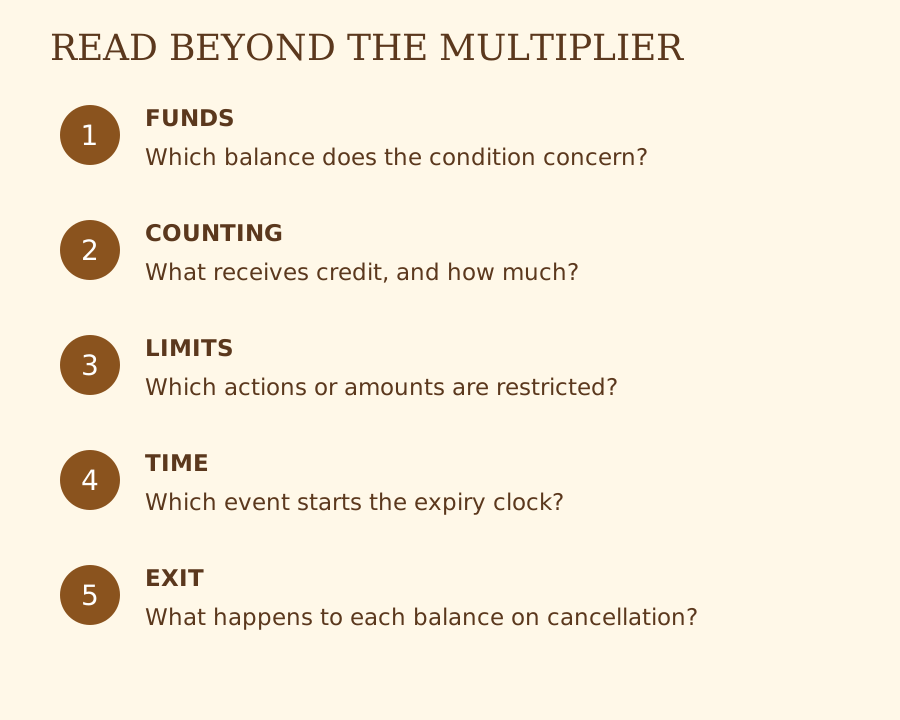
A compact personal record can use the five questions in our diagram: what funds, what counting rule, what limits, what timing and what exit consequence? Fill each from the actual document. A blank field is a research question, not permission to assume the most favourable answer.
The final test is whether the explanation changes meaning when its headline is read alone. If the important limitation appears only much later, bring it forward. Clear terms writing helps readers understand the commitment and its uncertainty without implying that an offer is easy money or that completing it guarantees a return.
Questions answered
Is a wagering requirement the amount I must deposit?
Not necessarily. In the examples here it is a stated turnover condition derived from a defined bonus base and multiplier. Deposit requirements, if any, are separate terms.
Does 25% contribution mean the game returns 25%?
No. It describes credit towards a requirement in the stated ledger. The game’s return and actual outcomes are separate questions.
What is the Great Britain bonus wagering cap date?
The Gambling Commission’s updated announcement gives 19 January 2026 for the maximum ten-times bonus wagering requirement. Check the exact promotion and applicable jurisdiction rather than use an old or overseas page.