Facts checked Article
A worked example
The wagering base: the clause, in plain English, with the arithmetic
A multiplier is incomplete information until the base is named. A £20 bonus-only base at ten times is £200 of qualifying turnover, and the contribution rate can turn that into £2,000 of stakes.
The wagering base: what the multiplier multiplies
Read the wagering base before the multiplier. A multiplier on its own is incomplete information, because ‘ten times’ says nothing until you know which amount is being multiplied.
In a hypothetical bonus-only example, a £20 bonus with a ten-times requirement means £200 of qualifying turnover. Turnover is the total value of qualifying bets, and it is not a loss, a balance or an amount you can withdraw.
A wagering requirement is, in the Gambling Commission’s glossary, ‘any requirement that a consumer must make wagers totalling a particular value for funds to become withdrawable’. That definition names the wagering base only indirectly, because the particular value is set by the promotion.
Three other conditions can change the arithmetic more than the multiplier does. They are the contribution rate, the maximum permitted stake and the expiry period, and each one is read below.
Sources: Gambling Commission: glossary of terms; Gambling Commission: incentives response, proposal 1; Gambling Commission: promotions news release.
The conditions, as the regulator defines them
- What a wagering requirement is
- The Commission’s glossary defines it as ‘any requirement that a consumer must make wagers totalling a particular value for funds to become withdrawable’.Gambling Commission: glossary of terms · as checked on
- What a bonus is
- The same glossary defines a bonus as ‘any funds or equivalent provided by the operator and added to a consumer’s account from which the consumer can place wagers’.Gambling Commission: glossary of terms · as checked on
- The cap, and the date it binds
- The consultation response records a maximum of up to 10 times wagering requirements within incentives, and states that the requirement comes into force on 19 January 2026.Gambling Commission: incentives response, proposal 1 · as checked on
- Our arithmetic from that definition
- A £20 bonus-only base at ten times is £200 of qualifying turnover. At a 20% contribution rate that needs £1,000 of stakes, which is 50 times the base.Gambling Commission: glossary of terms · as checked on
- Why the Commission set the cap at ten
- Its news release states that ‘capping the wagering requirement to ten decreases the likelihood of harm, reduces complexity, and improves transparency while maintaining consumer choice’.Gambling Commission: promotions news release · as checked on
Definitions and the cap are quoted from the three Gambling Commission pages we read on 22 September 2026. The pounds arithmetic is ours, worked from those definitions, and describes no named promotion.
Clause 1 — the base: the amount the multiplier acts on
The wagering base is the amount the promotion multiplies. In the Commission’s glossary, a bonus is ‘any funds or equivalent provided by the operator and added to a consumer’s account from which the consumer can place wagers’.
A bonus-only base is therefore the credit alone. Other promotions set the base as the deposit, or as the deposit plus the credit, and the conditions have to say which one applies.
Take the hypothetical £20 bonus. If the base is the credit alone, a ten-times requirement is £200 of qualifying turnover, but if the base were a £20 deposit plus a £20 credit, the same multiplier would mean £400.
That comparison is the whole argument for reading the wagering base first. The multiplier did not change between those two readings, and yet the turnover doubled.
Sources: Gambling Commission: glossary of terms.
Clause 2 — the multiplier: what ten times turns £20 into
The multiplier is the number of times the wagering base must be staked. Applied to a £20 bonus-only base, ten times means £200 of qualifying turnover.
Read that figure as stakes placed rather than money lost. A £200 turnover can be reached through many small stakes or fewer large ones, subject to the maximum permitted stake condition.
The Commission’s consultation response states the final rule in one line: ‘Licensees must not: Apply wagering requirements to incentives, which require customers to play through bonus funds, over a maximum of 10 times.’
The same passage restates the definition for the avoidance of doubt: ‘A wagering requirement is where a customer is required to make wagers totalling a particular value for funds to become withdrawable.’
Sources: Gambling Commission: incentives response, proposal 1.
Base, multiplier and contribution, in pounds
Enter the base the conditions name, the multiplier and the contribution rate for the game you intend to stake on. The outputs are the qualifying turnover required and the stakes needed to produce it.
Worked example: with base named by the conditions £20.00, multiplier 10 times, contribution rate for the game 20%, qualifying turnover required is £200.00 and stakes needed at that contribution rate is £1,000.00 and stakes as a multiple of the base is 50.0. A £20 base at ten times is £200 of qualifying turnover. At a 20% contribution rate that needs £1,000 of stakes, which is 50 times the base.
Formula and figures: Gambling Commission: glossary of terms
Arithmetic from this page, worked from the Commission’s definition of a wagering requirement. It accepts hypothetical figures for explanation, and it confirms nothing about any real promotion or its availability to you.
Clause 3 — contribution: why 10% means ten times the turnover
The contribution rate is the share of each stake that counts towards the requirement. It is set by game type, and a zero rate means a game makes no progress at all.
Work the £200 requirement through four rates. At 100%, £200 of stakes clears it, which is ten times the £20 base. At 50%, £400 of stakes is needed, or 20 times the base.
At 20% the figure is £1,000, which is 50 times the base. At 10% it is £2,000, or 100 times. At 0% no amount of staking moves the requirement, because nothing counts.
Contribution is not return to player, and the two are often read as though they were the same number. One decides how much you must stake; the other describes what a game returns over a very long run.
Sources: Gambling Commission: glossary of terms.
Stakes needed to clear £200 of qualifying turnover
| Contribution rate | Stakes needed | Multiple of the base | Evidence |
|---|---|---|---|
| 100% | £200 | Ten times the £20 base | · Gambling Commission: glossary of terms |
| 50% | £400 | 20 times the £20 base | · Gambling Commission: glossary of terms |
| 20% | £1,000 | 50 times the £20 base | · Gambling Commission: glossary of terms |
| 10% | £2,000 | 100 times the £20 base | · Gambling Commission: glossary of terms |
| 0% | No progress | Not applicable | · Gambling Commission: glossary of terms |
Clause 4 — the maximum bet and the expiry clock
Two further conditions can end progress early or void it outright. A maximum bet clause caps the stake permitted while a requirement is open, and a single stake above that cap can forfeit the bonus balance.
REDLINE. Any condition that voids a balance, caps a withdrawal or starts a period the reader cannot see belongs in this margin.
The expiry clock sets the period within which the requirement must be met. The conditions have to say what starts it, because a period that starts on credit is not the same as one that starts on the first qualifying stake.
The Commission’s glossary groups these under significant terms and conditions, which it describes as ‘the key restrictions which apply to a promotion’.
Sources: Gambling Commission: glossary of terms.
Five lines to find before the arithmetic is worth doing
Ticks are kept only in this browser and are never sent anywhere.
What changes on 19 January 2026
The Commission has capped the multiplier. Its news release states that ‘all changes will come into force on 19 January 2026’, and the consultation response gives the same date for this requirement.
The cap itself is ten. The response records the decision as ‘we recommend proceeding with Option B, to implement a maximum of up to 10 times wagering requirements within incentives’, after a consultation that offered one, five and ten times alongside a complete ban.
The reason is stated plainly in the same document. High value offers ‘are often constructed by applying high wagering requirements which could have negative and disproportionate effects on vulnerable adults’.
A second change lands on the same date. Gambling businesses ‘will be banned from offering potentially harmful offers involving consumers having to carry out two or more types of gambling, such as betting and playing slots’.
Sources: Gambling Commission: promotions news release; Gambling Commission: incentives response, proposal 1.
The amended condition, as the response prints it
Licensees must not: Apply wagering requirements to incentives, which require customers to play through bonus funds, over a maximum of 10 times.
How to read a wagering base before you agree to anything
Here is the order to read a set of conditions in, and it is not the order the page usually presents them in. Each step is a question with a written answer.
If the conditions do not answer a step, record that as unstated rather than estimating it. An estimate written beside a real clause reads later as though the clause said it.
The steps below work one wagering base through the £20 example, so the arithmetic stays visible at every stage.
Sources: Gambling Commission: glossary of terms.
Reading a wagering base, step by step
The result is a stakes figure and a list of anything the conditions left unstated. Neither is a judgement about whether a promotion is suitable for you.
Find the base
Read which amount the requirement applies to: the credit alone, the deposit, or both. Write that figure down before you read the multiplier.
Read the multiplier
Multiply the base by it. A £20 bonus-only base at ten times gives £200 of qualifying turnover.
Find the contribution rate
Take the rate for the game you intend to stake on, then divide the turnover by it. £200 at a 20% rate needs £1,000 of stakes.
Read the maximum permitted stake
Note the cap that applies while the requirement is open, and what the conditions say happens if a single stake exceeds it.
Read what starts the expiry period
Note the length of the period and the event that begins it. If the conditions do not say, record it as unstated.
Total the stakes and compare
Put the stakes figure beside the base. If the stakes needed run to many times the base, the condition is the expensive part, not the credit.
Write the date you read the conditions beside every figure you copy out.
What a wagering base costs in stakes
Total the wagering base arithmetic before agreeing to anything. On the £20 example at a 20% contribution rate, £1,000 of stakes is required to produce £200 of qualifying turnover.
That is 50 times the base, from a condition that reads as ten times. The distance between those two numbers is the entire reason to read the base first.
Nothing here says whether a promotion is worth accepting, because that judgement is not this page’s job. It records what the conditions cost in stakes and what can void them.
The cheapest response to a wagering requirement is not to accept the promotion at all. If bonus conditions are keeping you playing longer than you intended, GamCare’s helpline is 0808 8020 133.
Sources: Gambling Commission: glossary of terms.
What the terms do not say
Three things are commonly left unstated, and each of them changes the arithmetic. The first is whether the base includes the deposit as well as the credit.
The second is whether a contribution rate can change while a requirement is open. The third is what happens to a partly cleared requirement if the account is closed.
We read the Commission’s pages rather than any operator’s conditions, so nothing here describes a named promotion. Where an operator’s wording is needed, that operator’s own page is the source, and the date we read it belongs beside the quotation.
Next step: put your own wagering base, multiplier and contribution rate into the calculator above. Was this useful, or did we get something wrong? Tell us and we will correct it.
Sources: Gambling Commission: glossary of terms; Gambling Commission: promotions news release.
Five words used on this page
- Wagering requirements
- Conditions requiring a consumer to make wagers totalling a particular value before funds become withdrawable, in the Gambling Commission’s wording.
- Base
- The amount a wagering requirement applies to, which may be the credit alone, the deposit, or both.
- Multiplier
- The number of times the base must be staked before funds become withdrawable.
- Contribution rate
- The share of each stake that counts towards a wagering requirement, set by game type.
- Qualifying turnover
- The total value of bets that count towards a requirement once contribution has been applied.
Terms read 22 September 2026
Three Gambling Commission pages were opened on 22 September 2026, and each is listed below with the part of this page it supports. No operator’s conditions were read for this revision.
The arithmetic is ours and uses one hypothetical £20 base throughout. It confirms nothing about any real promotion, and it does not establish that a promotion is compliant or available to you.
Clause numbering here follows this site’s convention. Where a source does not number its conditions, we number by heading and say so, which is what the four clause headings above do.
Sources: Gambling Commission: glossary of terms; Gambling Commission: promotions news release; Gambling Commission: incentives response, proposal 1.
Pages read
Each page was opened on 22 September 2026. Re-check dates sit before the 19 January 2026 commencement.
| Source | Publisher | Read on | Re-check due | Note |
|---|---|---|---|---|
| Gambling Commission: glossary of terms | Gambling Commission | Definitions of a wagering requirement, a bonus, a promotion and significant terms and conditions. | ||
| Gambling Commission: promotions news release | Gambling Commission | The 19 January 2026 commencement, the reason given for the cap, and the ban on mixed-product offers. | ||
| Gambling Commission: incentives response, proposal 1 | Gambling Commission | Proposal 1: the ten-times decision, the amended SR Code wording and the evidence on high wagering requirements. |
Questions answered
What is the wagering base?
The base is the amount a wagering requirement multiplies. It may be the bonus credit alone, the deposit, or both, and the conditions have to say which. On a £20 bonus-only base, a ten-times requirement is £200 of qualifying turnover.
Does ten times mean staking £200 on a £20 bonus?
Only at a 100% contribution rate. At 20% that same £200 requirement needs £1,000 of stakes, and at 10% it needs £2,000, because the contribution rate decides how much of each stake counts.
What is the maximum wagering requirement in Great Britain?
The Gambling Commission's consultation response records a maximum of up to 10 times wagering requirements within incentives, and states that the requirement comes into force on 19 January 2026.
Is turnover the same as a loss?
No. Turnover is the total value of qualifying bets. It is not a loss, a balance or an amount that can be withdrawn, and this page computes no return of any kind.
What else changes on 19 January 2026?
The Commission's news release states that gambling businesses ‘will be banned from offering potentially harmful offers involving consumers having to carry out two or more types of gambling, such as betting and playing slots’.
Does the arithmetic on this page apply to a real promotion?
No. Every figure uses one hypothetical £20 base. They confirm nothing about any named promotion, and they do not establish that a promotion is compliant or available to you.
Original guidance
Continue reading

Game contribution is not return to player
Two percentages can appear in the same document while measuring completely different things.
Read Game contribution is not return to player
Which event starts a casino bonus expiry clock?
An offer closing, a reward arriving and a bonus expiring are different events. A deadline worksheet shows how to preserve the distinction without turning the clock into pressure to play.
Read Which event starts a casino bonus expiry clock?
Read a casino bonus maximum bet against the whole round
A percentage cap and a cash cap can appear in the same bonus terms. The amount, the balance and the unit of play all need reading before either number means much.
Read Read a casino bonus maximum bet against the whole round
How to calculate wagering requirements: the clause, in plain English, with the arithmetic
Bonus × multiplier gives the turnover; turnover ÷ contribution gives the stakes; stakes × house edge gives the cost. On £20 at the 10× ceiling and a 30% game that is £200, £666.67 and about £26.67. The clauses, quoted and dated, with a calculator.
Read How to calculate wagering requirements: the clause, in plain English, with the arithmetic
Wagering requirements explained: the base, the multiplier and the contribution rate decide what you actually stake
What a wagering requirement is in the Gambling Commission’s words, how the base, multiplier and game contribution turn a £20 bonus into £200 or £2,000 of stakes, and a calculator that shows every step.
Read Wagering requirements explained: the base, the multiplier and the contribution rate decide what you actually stake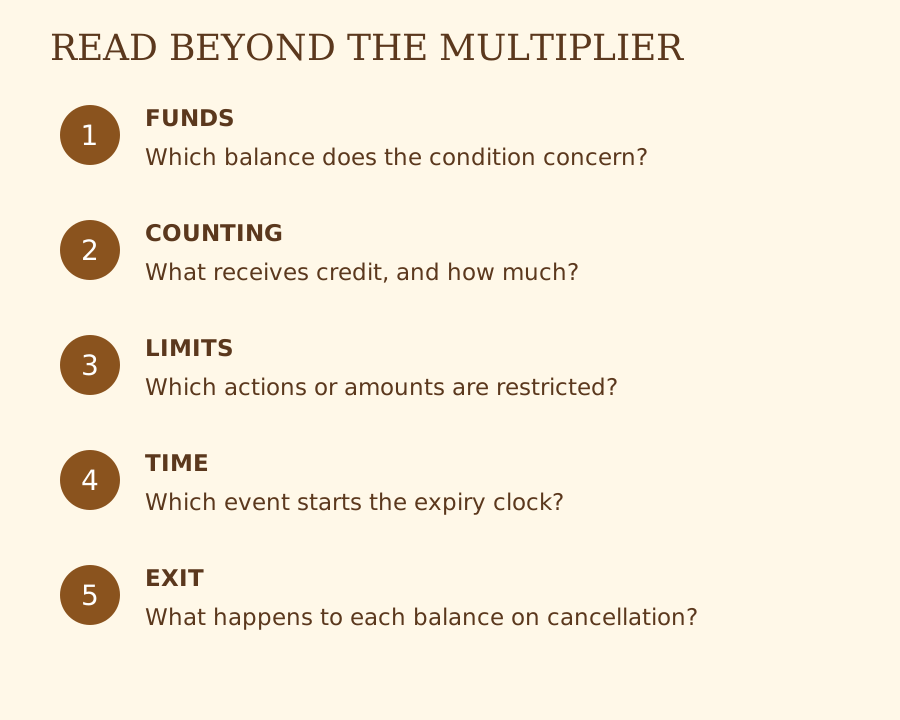
UK casino bonus terms: what do wagering, contribution and expiry mean?
Read the conditions around a bonus balance, using a William Hill help-page example, current Great Britain context and an original contribution worksheet.
Read UK casino bonus terms: what do wagering, contribution and expiry mean?
Continue reading
How to calculate wagering requirements: the clause, in plain English, with the arithmetic
Bonus × multiplier gives the turnover; turnover ÷ contribution gives the stakes; stakes × house edge gives the cost. On £20 at the 10× ceiling and a 30% game that is £200, £666.67 and about £26.67. The clauses, quoted and dated, with a calculator.
Read How to calculate wagering requirements: the clause, in plain English, with the arithmeticWhich event starts a casino bonus expiry clock?
An offer closing, a reward arriving and a bonus expiring are different events. A deadline worksheet shows how to preserve the distinction without turning the clock into pressure to play.
Read Which event starts a casino bonus expiry clock?Read a casino bonus maximum bet against the whole round
A percentage cap and a cash cap can appear in the same bonus terms. The amount, the balance and the unit of play all need reading before either number means much.
Read Read a casino bonus maximum bet against the whole roundGame contribution is not return to player
Which event starts a casino bonus expiry clock?
Read a casino bonus maximum bet against the whole round
How to calculate wagering requirements: the clause, in plain English, with the arithmetic
UK casino bonus terms: what do wagering, contribution and expiry mean?