Facts checked Article
Terms decoder
Read a casino bonus maximum bet against the whole round
A percentage cap and a cash cap can appear in the same bonus terms. The amount, the balance and the unit of play all need reading before either number means much.
A maximum bet needs a unit and a balance
A bonus maximum bet is a restriction on a stake under particular promotional terms. To understand it, identify the amount allowed, what counts as one bet or round, which funds it covers and how long the restriction lasts. A number detached from those conditions is not a usable account of the clause.
This reading uses 32Red's public promotional terms retrieved on 19 September 2026. Clause 5 lists a restriction based on 30% of the initial bonus for a game round, and another based on £15 per slot spin while using bonus funds. Those are two statements with their own wording, not two interchangeable descriptions of a universal maximum.
We examine the document, not an offer available to a particular account. No bonus was accepted and no game was played. The calculation below is designed to expose how simultaneous restrictions work.
It does not recommend a stake, confirm eligibility or establish that a particular transaction complied with every promotion condition.
Sources: Promotional Terms and Conditions; Free offers and bonuses.
Clause 5 — the two restrictions, as read on 19 September 2026
- Percentage restriction
- Clause 5 lists a restriction based on 30% of the initial bonus for a game round. The base is the initial bonus amount, not a later balance that includes winnings.Promotional Terms and Conditions · as checked on
- Cash restriction
- Another restriction is based on £15 per slot spin while using bonus funds. The funding condition stays attached to the number.Promotional Terms and Conditions · as checked on
- Two statements, not one maximum
- Those are two statements with their own wording, not two interchangeable descriptions of a universal maximum. Where both apply, a stake must satisfy both.Promotional Terms and Conditions · as checked on
- Four things to identify
- The amount allowed, what counts as one bet or round, which funds it covers and how long the restriction lasts. A number detached from those conditions is not a usable account of the clause.Free offers and bonuses · as checked on
- Promotion terms prevail
- The introduction states that promotion terms prevail over standard terms if they differ, so a general page alone cannot settle every account-specific question.Promotional Terms and Conditions · as checked on
Two statements with their own wording. This reading examines the document, not any promotion available to a particular account; no bonus was accepted and no game was played.
Mark the operative words before doing arithmetic
The short phrase “initial bonus amount” identifies the base for the percentage calculation. It is different from a later balance that happens to include winnings. The phrase “any one game round” identifies the unit.
Clause 5 gives game examples, including a slot or roulette spin and a blackjack hand. The percentage restriction continues until wagering requirements have been met.
The slot-specific sentence refers to a stake above £15 per spin while using bonus funds. Keep that funding condition attached when summarising it. Do not silently rewrite it as a lifetime account limit or a rule for every cash-funded spin on the site.
The introduction also states that promotion terms prevail over standard terms if they differ. A particular promotion may have further instructions. That is why a general page alone cannot settle all account-specific questions.
Record the promotion and version involved, as well as the general terms.
Our method is to annotate a clause in four fields: base, unit, condition and consequence. This creates a small, repeatable reading task. It avoids starting with a calculator that has already assumed which balance and which event the number refers to.
Sources: Promotional Terms and Conditions.
How to annotate a maximum bet clause in four fields
The reading task the prose describes: base, unit, condition and consequence, written down before any calculator assumes which balance and which event the number refers to.
Base — the initial bonus amount
The phrase initial bonus amount identifies the base for the percentage calculation. It is different from a later balance that happens to include winnings.
Unit — any one game round
The phrase any one game round identifies the unit. Clause 5 gives game examples, including a slot or roulette spin and a blackjack hand.
Condition — bonus funds, until wagering is met
The slot-specific sentence refers to a stake above £15 per spin while using bonus funds; keep that funding condition attached. The percentage restriction continues until wagering requirements have been met.
Consequence — the version and the stated reason
Record the promotion and version involved, as well as the general terms, since promotion terms prevail over standard terms if they differ. Later, record the actual reason given rather than an automatic rule.
What the result means
A small, repeatable reading task. Two readers can reproduce the interpretation without relying on adjectives such as generous or restrictive, and without silently rewriting a per-spin condition as a lifetime account limit.
Compare the two ceilings only where both apply
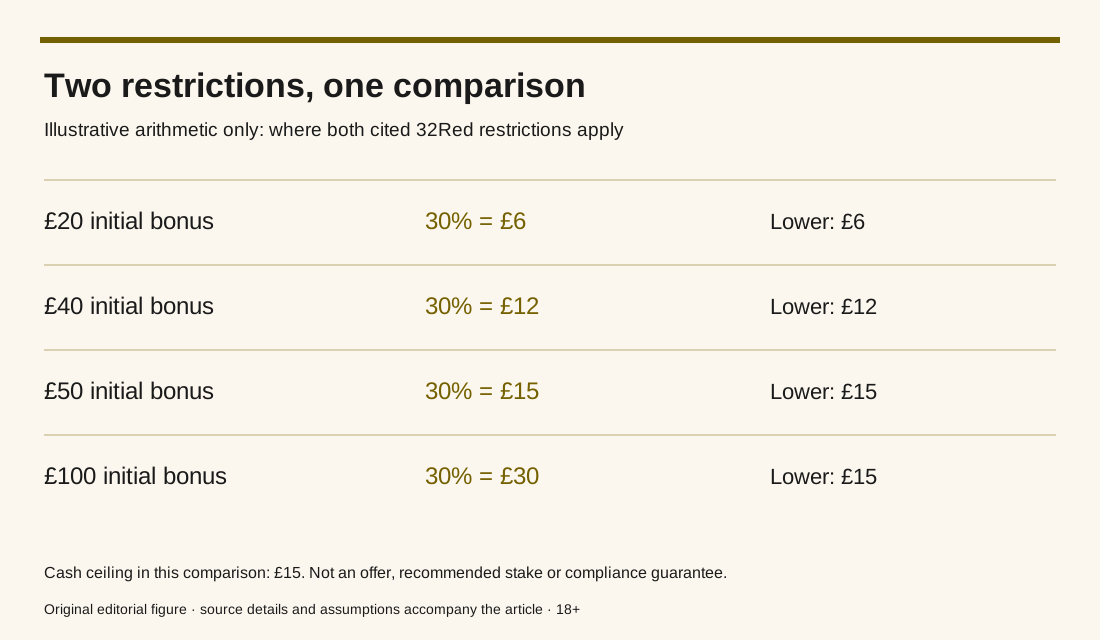
Take a hypothetical £20 initial bonus. Thirty per cent is £6: £20 × 0.30 = £6. If both the percentage restriction and the £15 slot restriction apply to the round being considered, the tighter numerical ceiling is £6.
A £10 stake would be below £15 yet above £6. Passing one comparison does not pass the other.
Repeat the arithmetic for an initial bonus of £40, £50 and £100. The percentage amounts are £12, £15 and £30. Where both restrictions apply, the lower amounts are respectively £12, £15 and £15.
These are invented bonus sizes used to read the clauses; they are not current advertised offers.
The crossover is £50 because £15 ÷ 0.30 = £50. Below that base the percentage amount is smaller. Above it the cash amount is smaller.
At the crossover they coincide. This conclusion follows from arithmetic, not from an observed operator decision.
The figure shows the four cases together. Its heading includes the condition that both restrictions apply. Removing that condition would make the chart look like an unconditional permission to stake the displayed amount, which it is not.
Other terms, eligibility rules and the meaning of the round still need checking.
| Hypothetical initial bonus | Percentage restriction | Lower ceiling if both apply |
|---|---|---|
| £20 initial bonus | 30% = £6 | Lower: £6 |
| £40 initial bonus | 30% = £12 | Lower: £12 |
| £50 initial bonus | 30% = £15 | Lower: £15 |
| £100 initial bonus | 30% = £30 | Lower: £15 |
Sources: Promotional Terms and Conditions.
The largest permitted amount is not a suggested amount
A ceiling tells you where a restriction begins. It does not say that betting up to it is sensible, affordable or necessary. Reading a clause accurately does not make a bonus profitable.
The worked amounts are included so that two readers can reproduce the interpretation without relying on adjectives such as generous or restrictive.
Nor does the maximum bet tell you how much of a stake counts towards wagering. Contribution is a separate condition. A £1 stake can be below a cap and still contribute nothing if the chosen game is excluded.
Conversely, a game could ordinarily contribute in full while a particular stake breaches a separate restriction.
The expiry clock is another independent condition. Dividing turnover by a maximum stake does not produce a plan that can safely be completed before a deadline. It leaves out losses, game eligibility, changing balances and the decision to stop.
This article does not turn the clause calculation into a suggested number of rounds.
Keeping those fields separate is the useful result. It lets a reader see why a headline wagering multiplier cannot stand in for the full set of conditions.
Terms used in this reading
- Wagering requirements
- The total qualifying turnover that must be staked before the requirement is met; a separate condition from the per-round stake restriction.
- Turnover
- The running total of stakes placed. Dividing it by a maximum stake does not produce a plan that can safely be completed before a deadline.
- Contribution
- The share of a stake that counts towards the wagering requirement. An excluded game can contribute nothing even when the stake is below the cap.
- Initial bonus amount
- The base the percentage restriction is calculated from; not a later balance that happens to include winnings.
- Game round
- The unit the restriction applies to. Clause 5's examples include a slot or roulette spin and a blackjack hand.
- Expiry clock
- The time limit attached to the promotion; an independent condition from the stake cap and from the wagering total.
Do not substitute a screen label for the recorded round
A disputed maximum-bet decision needs a transaction record that can be matched to the contractual unit. The stake shown on one control, the sum shown in a history entry and a label such as total bet may refer to different things. This is a reason to ask for clarification, not a claim about how any named game implements its controls.
For a hypothetical dispute, make one row containing the round identifier, timestamp, recorded stake, funding balance, applicable clause and operator explanation. If the operator says several entries form one round, ask it to identify the grouping and the rule that supports it.
Do not assume that visually separate actions must be separate rounds, or that a single displayed total necessarily proves the contractual stake.
We have not sourced a general treatment of feature purchases, side bets or split hands under these particular promotional terms. Those questions remain open rather than being answered by analogy. The page's examples help identify the intended unit but do not document every possible game event.
A missing definition should stay visible in the record. Adding a plausible interpretation after a loss would make the explanation neater while making its evidential basis weaker.
Sources: Promotional Terms and Conditions.
One row for a hypothetical dispute
Each entry is matched to the contractual unit, not to a screen label. If the operator says several entries form one round, ask it to identify the grouping and the rule that supports it.
Ticks are kept only in this browser and are never sent anywhere.
Keep deposit money separate from restricted funds
The CMA's advice says players should be able to leave with their remaining deposit and winnings earned from that deposit. It also says businesses must distinguish their own-money play from bonus funds and make restrictions such as bet-size limits clear. The Commission's consumer guidance repeats that distinction.
Consequently, an account balance is not enough information to describe a forfeiture. Ask which component the operator says is affected: the original bonus, winnings attributed to bonus funds, deposit money or some combination. Then ask which clause and transaction support that attribution.
These are separate questions from whether the recorded stake exceeded a number.
Consider an invented account display showing £80. Without a funding breakdown, that £80 cannot tell us how much is deposited cash or restricted promotional money. We therefore do not calculate a forfeiture from the display total.
The useful evidence is the balance ledger and the operator's stated allocation method.
This is an editorial reading procedure, not a determination that a particular deduction is lawful. The CMA makes clear that unfair terms cannot be enforced. The mere presence of wording on a website does not settle fairness or an individual dispute.
Sources: Online gambling promotions: advice for gamblers; Free offers and bonuses.
A stated consequence still needs a stated reason
Clause 5 describes potential consequences of conduct it treats as abuse, including forfeiture of promotional benefits and possible exclusion or account closure. Record the actual reason given in the case rather than replacing the language with an automatic rule that every over-cap event always produces the same result.
The current Commission rewards-and-bonuses code requires clear, fair, transparent and accessible terms. Its wagering cap is a separate rule about play-through requirements. It does not supply a universal bonus maximum stake or resolve how an individual round should be grouped.
If an explanation is unclear, a focused written request is more useful than a conclusion: identify the applicable version of the clause, the round said to breach it, the calculation, the balance affected and the remedy sought. Preserve the reply beside the terms that applied when the promotion was accepted.
The CMA points consumers first to the business's complaints process when they believe they have been treated unfairly. This article stops at making the clause issue legible. It does not promise a refund or predict how a complaint reviewer will decide.
Sources: Promotional Terms and Conditions; Online gambling promotions: advice for gamblers; 5.1.1 – Rewards and bonuses.
A focused written request, in five parts
More useful than a conclusion when an explanation is unclear. Preserve the reply beside the terms that applied when the promotion was accepted.
Ticks are kept only in this browser and are never sent anywhere.
Keep a compact clause record
Use a six-entry note: promotion name, accepted terms, initial bonus, stake unit, relevant funding balance and stated consequence. Add the actual round record only if there is a dispute. A note containing only maximum bet £15 would miss the percentage comparison and the condition attached to the slot sentence in our example.
Preserve the wording and retrieval date. A page read today is evidence of today's displayed terms, not proof that the same text governed an earlier promotion. If you do not have the accepted version, label that gap and request it.
Do not backdate a newly saved copy.
The outcome may be that the wording remains too unclear to apply confidently. That is a legitimate result of reading the evidence. There is no need to accept a promotion, make another deposit or continue playing to complete this exercise.
For adults only; choosing not to gamble avoids the need to meet any promotional condition.
The six-entry clause note
Add the actual round record only if there is a dispute. Preserve the wording and the retrieval date; a page read today is evidence of today's displayed terms, not proof that the same text governed an earlier promotion.
Ticks are kept only in this browser and are never sent anywhere.
Questions answered
Does a bonus maximum bet increase when my balance grows?
The cited percentage clause uses the initial bonus amount, not a later balance. A growing display balance therefore does not change that stated base.
Which applies if the terms give a percentage and a cash limit?
Check the scope of each clause. Where both cited restrictions apply, a stake must satisfy both, so the smaller numerical ceiling controls the comparison.
Does staying below the maximum complete the wagering requirement?
No. A per-round stake restriction and the total qualifying turnover are separate conditions. Game contribution, eligibility and expiry still need their own checks.
What should I do if I think I have been treated unfairly?
Use the gambling business’s complaints process and identify the term, round and balance at issue. The CMA’s consumer guidance explains the expectation of clear restrictions and fair terms.
Where do the percentage cap and the cash cap coincide?
At an initial bonus of £50, because £15 ÷ 0.30 = £50. Below that base the percentage amount is smaller; above it the cash amount is smaller. This follows from arithmetic, not from an observed operator decision.
What should a compact clause record contain?
A six-entry note: promotion name, accepted terms, initial bonus, stake unit, relevant funding balance and stated consequence. Add the actual round record only if there is a dispute.
Can an account balance show how much has been forfeited?
No. Without a funding breakdown a display total cannot tell you how much is deposited cash or restricted promotional money. The useful evidence is the balance ledger and the operator's stated allocation method.
Original guidance
Continue reading

Game contribution is not return to player
Two percentages can appear in the same document while measuring completely different things.
Read Game contribution is not return to player
Which event starts a casino bonus expiry clock?
An offer closing, a reward arriving and a bonus expiring are different events. A deadline worksheet shows how to preserve the distinction without turning the clock into pressure to play.
Read Which event starts a casino bonus expiry clock?
How to calculate wagering requirements: the clause, in plain English, with the arithmetic
Bonus × multiplier gives the turnover; turnover ÷ contribution gives the stakes; stakes × house edge gives the cost. On £20 at the 10× ceiling and a 30% game that is £200, £666.67 and about £26.67. The clauses, quoted and dated, with a calculator.
Read How to calculate wagering requirements: the clause, in plain English, with the arithmetic
The wagering base: the clause, in plain English, with the arithmetic
A multiplier is incomplete information until the base is named. A £20 bonus-only base at ten times is £200 of qualifying turnover, and the contribution rate can turn that into £2,000 of stakes.
Read The wagering base: the clause, in plain English, with the arithmetic
Wagering requirements explained: the base, the multiplier and the contribution rate decide what you actually stake
What a wagering requirement is in the Gambling Commission’s words, how the base, multiplier and game contribution turn a £20 bonus into £200 or £2,000 of stakes, and a calculator that shows every step.
Read Wagering requirements explained: the base, the multiplier and the contribution rate decide what you actually stake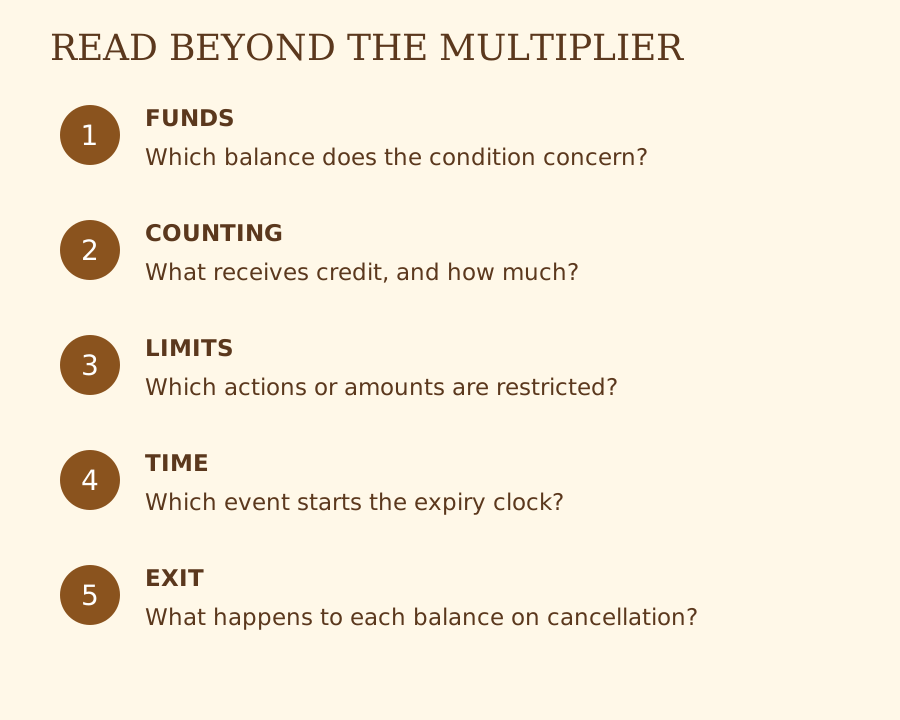
UK casino bonus terms: what do wagering, contribution and expiry mean?
Read the conditions around a bonus balance, using a William Hill help-page example, current Great Britain context and an original contribution worksheet.
Read UK casino bonus terms: what do wagering, contribution and expiry mean?
Continue reading
How to calculate wagering requirements: the clause, in plain English, with the arithmetic
Bonus × multiplier gives the turnover; turnover ÷ contribution gives the stakes; stakes × house edge gives the cost. On £20 at the 10× ceiling and a 30% game that is £200, £666.67 and about £26.67. The clauses, quoted and dated, with a calculator.
Read How to calculate wagering requirements: the clause, in plain English, with the arithmeticWhich event starts a casino bonus expiry clock?
An offer closing, a reward arriving and a bonus expiring are different events. A deadline worksheet shows how to preserve the distinction without turning the clock into pressure to play.
Read Which event starts a casino bonus expiry clock?Game contribution is not return to player
Two percentages can appear in the same document while measuring completely different things.
Read Game contribution is not return to playerThe wagering base: the clause, in plain English, with the arithmetic
Game contribution is not return to player
Which event starts a casino bonus expiry clock?
How to calculate wagering requirements: the clause, in plain English, with the arithmetic
UK casino bonus terms: what do wagering, contribution and expiry mean?